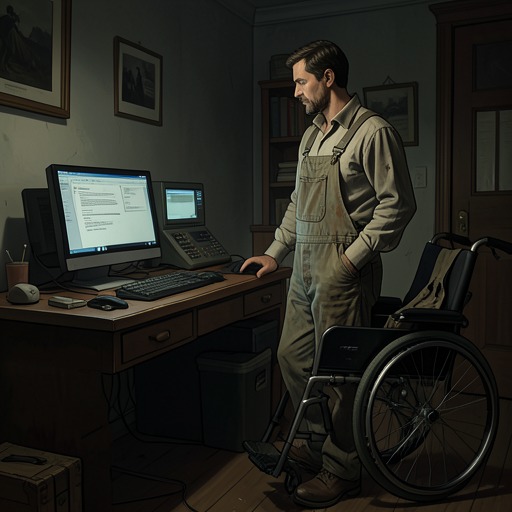
The Withheld-Evidence Bluff
Mr. MercedesThe Withheld-Evidence Bluff is K. William Hodges’s deliberate use of an unspecified piece of evidence to provoke Brady Hartsfield into revealing his knowledge of the Mercedes murders. Rather than immediately disclose what he knows, Hodges tells Brady that there is something a false confessor could not know, then waits for the killer to supply the incriminating detail himself. The tactic transforms an online taunt into a test of authorship: Brady’s angry response identifies him as the real Mercedes Killer, and the missing valet key becomes the concrete clue that completes the trap.
Origin and Purpose
The bluff grows out of Hodges’s awareness that Brady may be watching him. After recognizing that the killer has been near his house, Hodges considers how to keep the correspondence going without allowing Brady to retreat. He thinks of the exchange as fishing: Brady is a wary catch who must be drawn toward a meeting carefully, and Hodges needs to deepen the hook without snapping the line.
A remark from Pete Huntley gives Hodges the idea for the next message. He writes and revises it until it is short and pointed: there is something about the crime that a false confessor could not know, and the real culprit would know only if he had inspected the stolen car closely. Crucially, Hodges does not name the detail. He lets the claim itself create pressure, betting that Brady’s need to correct him will outweigh his caution.
The tactic also extends Hodges’s return to investigative work. He is retired, but the anonymous challenge has given him a renewed sense of purpose; he has already considered turning any progress over to Pete. The bluff is not an official interrogation or an evidentiary disclosure. It is an improvised investigative maneuver carried out through their online exchange, with Hodges knowingly using the uncertainty of what he has withheld as leverage.
The Bait and Brady’s Response
Hodges’s message presents itself as a challenge to the false confession. He taunts Brady with the possibility that the real killer checked the Mercedes from end to end before getting in, then leaves the reader and Brady to wonder what detail he means. The missing information is the mechanism: the assertion becomes useful precisely because it is incomplete.
Brady has already been angered by Hodges’s earlier posts. When Hodges adds that Donald Davis, the man who has confessed to the City Center killings, will soon confess to more, Brady cannot tolerate the possibility that another person will receive credit for his crime. The reference to a valet key sharpens that fear. Brady repeats the phrase to himself, questions whether such a key existed, and worries that Davis’s confession will deprive him of the triumph he believes is his.
He then answers in a rush, his hands shaking as he types. Brady insists that the key was not in the ignition, but says that it was a spare in the glove compartment and that the way he unlocked the car is for Hodges to figure out. He emphatically declares that Donald Davis did not commit the crime and threatens Hodges. In trying to rebut the bluff, Brady supplies precisely the kind of knowledge Hodges was testing for: he knows how the car was accessed and reacts as its actual thief and killer would.
The Missing Key Revealed
Hodges’s next message discloses the specific fact he had held back. Olivia Trelawney had both keys; the missing one was the valet key, stored in a small magnetic box beneath the Mercedes’s rear bumper. By naming the hiding place and the key Brady has confused with a spare in the glove compartment, Hodges turns an insinuation into a demonstrable gap between Brady’s account and the facts.
The revelation also explains why the bait worked. Brady’s response did not merely deny the accusation or reject the premise: he volunteered a specific account of a key and the way he unlocked the car. Hodges had withheld the decisive information long enough for Brady to make that disclosure first. The exchange thus has a clear sequence—an unexplained claim, Brady’s corrective outburst, and the precise fact that exposes the limits of his supposed knowledge.
Hodges further uses the message to remind Brady that he has threatened to kill him and to challenge him to come to Hodges’s home. Brady, reading the taunt at a computer in the back row of Discount Electronix, is enraged but quickly hides the screen when Freddi Linklatter approaches. His attempt to conceal the exchange underscores the practical danger of their contest: the bluff has reached him, but he cannot answer publicly without exposing what he has been doing.
Consequences and Narrative Significance
The withheld detail changes the correspondence from a contest of insults into a struggle over who controls the facts. Hodges’s claim that he possesses knowledge Brady lacks is initially a calculated provocation, not the clue itself. Brady’s angry insistence that Davis is not the killer makes the provocation consequential, while the hidden valet key gives Hodges’s maneuver its factual foundation.
The method is risky by design. Hodges recognizes that if his inference is wrong, Brady may see through the claim and break off contact. He nevertheless chooses to delay the reveal, using the pressure of uncertainty to make Brady act. That choice links the bluff to the larger fisherman-and-fish conceit: Hodges wants to draw his opponent closer, but every tug risks losing him.
The scene’s dramatic irony comes from the difference between what each man knows and what each thinks the other knows. Brady reads the message as an attack on his claim to the Mercedes crime and responds by defending details of the theft. Hodges, meanwhile, understands that the defensive answer itself is evidence. The missing valet key therefore functions both as a physical clue and as the instrument of a psychological test: it converts Brady’s need to correct the record into an unintended admission of knowledge.
The exchange also marks a change in Hodges’s post-retirement life. His private investigation is becoming active work, not simply a reason to imagine himself as a hard-boiled detective. Through an improvised bluff, he applies the habits of an investigator—isolating a detail, considering what a suspect could know, and shaping a question to elicit a response—while accepting that he is operating outside ordinary police procedure. The tactic’s force lies in that combination of concrete evidence and controlled omission: the fact is already there, but Hodges makes Brady reveal why it matters.